

A Guide to Ocular Inflammatory Disease
This guide was developed to provide you with information about your eye disease in order to help you participate in your care. Being informed is an important tool in your recovery.
Anatomy of the Eye
The middle layer of the eye is called the uvea or uveal tract. It is made up of the iris, the ciliary body, and the choroid. The uvea surrounds the eye like a tunic (coat). The visible part of the uvea, in the front, is the iris. Inflammation in any of the parts of the uveal tract is called uveitis. Inflammation inside the eye is a medical emergency because, untreated, it will lead to vision loss. Click here to print a diagram of the eye.
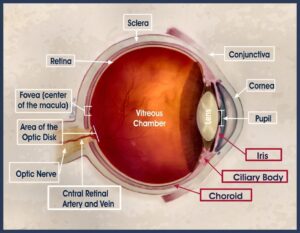
In this drawing, the eye is viewed from the top.
What is Ocular Inflammatory Disease?
Ocular inflammatory disease (OID) is a general term for inflammation affecting any part of the eye or surrounding tissue. Inflammation involving the eye can range from the familiar allergic conjunctivitis of hay fever to rare, potentially blinding conditions such as uveitis, scleritis, episcleritis, optic neuritis, keratitis, orbital pseudotumor, retinal vasculitis, and chronic conjunctivitis.
Broadly speaking, if inflammation develops in the eye(s), or in the optic nerve, blood vessels, muscles or other tissues that surround the eye, the resulting illness is classified as an ocular inflammatory disease (or OID for short).
The location of the inflammation governs the diagnostic name for the ocular inflammatory disease. For example, uveitis is inflammation in the uveal tract; scleritis is inflammation of the sclera, pars planitis is inflammation of the pars plana, and so forth.
The Immune System | What is inflammation?
Literally speaking, inflammation means setting on fire. Inflammation can develop in any part of the body, including the eyes and their surrounding structures. Inflammation is a characteristic reaction of tissue to injury or disease. Inflammation results from the body’s attempt to eliminate a foreign body or germ and helps to prevent further injury.
Inflammation is marked by four signs: swelling, redness, heat, and pain. You have probably observed the signs of inflammation in a cut or burn on your hand.
Inflammation is a complex process involving many different kinds of white blood cells: granulocytes (neutrophils, basophile, and eosoniphils) and some immune specific white blood cells called B and T lymphocytes along with their antibodies and cytokines. In all inflammatory diseases there is the migration of these specific types of white blood cells out of the bloodstream into surrounding tissues. These cells release agents (chemicals), such as cytokines, to boost immune responses and kill invading bacteria, viruses, and parasites or anything that the immune system perceives as foreign (antigen), or non-self. Part of their response is bringing antibodies (proteins in the family of immunoglobulins) to the site; the antibodies then attach to antigens and mark them for death. Antigens are anything that the immune system recognizes as non-self or foreign and, therefore, trigger an immune response. The linking of the antibody to the antigen forms an immune complex. Immune complexes circulate through the blood. Usually they are removed quickly, but occasionally they are lodged into tissues and cause inflammation.
Normal healthy tissue can be injured by inflammation during this process (innocent bystander injury). When this happens in or around the eyes, the affected region (the eyes, the eyelids, the sclera, the iris, the uvea, the retina, the optic nerve) becomes red, sore, and swollen. This inflammation can be observed by the eye doctor using a slit lamp microscope. If eye inflammation is long lasting (chronic) or severe, damage to delicate tissues and blood vessels in and around the eye can occur, resulting in vision loss.
Autoimmunity
The immune system is designed to protect and defend the body from foreign intruders (germs). The mechanisms of the immune system reside in the body, not in the eye. The immune system is complex. Essentially, it contains several different types of cells, some of which function like security guards, which are constantly on patrol looking for any foreign invaders. When they spot one, they take action and eliminate the intruder.
In some forms of ocular inflammatory disease, the immune system loses its ability to tell the difference between a foreign intruder and a person’s own normal tissues and cells. So, in essence, the guarding cells lose their memory, and they mistakenly identify the person’s own normal cells as foreign (antigens) and, subsequently, take action to eliminate them.
This dysregulation of the immune system is termed autoimmunity, or immune attack against self. The reason why this happens is unknown. The result of autoimmunity is chronic inflammation.

Autoimmune-mediated Ocular Inflammatory Disease
Autoimmune diseases are characterized by the body’s immune responses being directed against its own tissues, causing prolonged inflammation and subsequent tissue destruction. A number of autoimmune diseases exist, the most familiar of which is rheumatoid arthritis. In rheumatoid arthritis, the dysregulated immune system attacks the joints.
A number of autoimmune diseases exist in which the eye or various parts of the eye may be attacked. In ocular inflammatory disease, often the autoimmune disease is systemic, not only involving the eye but a variety of organs throughout the body. The most common examples of such diseases include rheumatoid arthritis, systemic lupus erythematosus, polyarteritis nodosa, relapsing polychondritis, Granulomatosis with Polyangiitis (formerly called Wegener’s), scleroderma, Behcet’s disease, inflammatory bowel disease (Crohn’s disease and ulcerative colitis), sarcoidosis, and ankylosing spondylitis.
However, the eye may in certain instances be the specific and only target affected by certain autoimmune diseases. Some such diseases include ocular cicatricial pemphigoid, Mooren’s corneal ulcer, and some forms of uveitis, including Birdshot retinochoroidopathy, Vogt-Koyanagi-Harada syndrome, and sympathetic ophthalmia.
What are the Signs and Symptoms of Ocular Inflammatory Disease?
Inflammation can affect any part of the eye or its surrounding structures. The symptoms of inflammation for the most part depend on the area in the eye of the inflammation. Most common signs and symptoms are:
- Pain: Eye pain, severe light sensitivity, and any change in vision are considered emergency signs and need immediate attention by an ophthalmologist.
- Redness
- Floaters
- Decreased vision
- Light sensitivity
What Causes Ocular Inflammatory Disease?
The forms of ocular inflammatory diseases that are most commonly seen include ocular allergy, cicatricial pemphigoid, scleritis, peripheral ulcerative keratitis, retinal vasculitis, chronic conjunctivitis, and anterior, intermediate, and posterior uveitis. OID occurs throughout the world. There are over 85 causes of uveitis/OID. They can be infectious or noninfectious, traumatic, drug-induced, or malignant. Both women and men of any race, ethnicity, or age may develop OID.
Infectious causes may be bacteria, parasites, fungus, viruses such as rubella, HIV; sexually transmitted diseases such as syphilis, Chlamydia, or gonorrhea; or rare infections, such as tuberculosis, toxoplasmosis, or Lyme disease.
There are several causes of noninfectious OID, one of which is autoimmune disease. In many cases, the autoimmune disease is systemic (affecting the body) and, also, produces inflammation in specific parts of the eye. The ocular inflammatory disease will then be identified according to that part of the eye which has inflammation. For example, juvenile rheumatoid (or idiopathic arthritis) is associated with inflammation in the anterior part of the eye, known as anterior uveitis or iritis. The area of inflammation in the eye also is helpful to the doctor in the development of differential diagnoses to detect the cause of your OID.
Autoimmune diseases can also affect just the eye; such as in the following ocular diseases: Birdshot retinochoroidopathy, Fuchs’ heterochromic iridocyclitis, Vogt-Koyanagi-Harada, ocular cicatricial pemphigoid. The other cause of noninfectious OID is termed idiopathic. Idiopathic OID is basically a diagnosis of exclusion. That is, no infection or associated systemic illness can be identified at the time of the diagnosis of eye inflammation. In this instance, inflammation is located entirely in the eye or its structures. This form of OID does not tend to have blood tests that can be used to follow the disease course. The inflammation is evaluated by the doctor using the slit lamp.
Drug or medication can also be the cause of ocular inflammatory disease. Some drug examples are bisphosphonates, cidofovir, rifabutin, and sulfonamides or topical corticosteroids and latanoprost. Vaccines and even skin tattoos can be inducers of OID. Certain cancers can cause ocular inflammatory disease, such as lymphoma, lung cancer, and breast cancer.
Why Are There So Many Names for Eye Inflammation?
Itis is the Greek suffix for inflammation. This suffix is often combined with the name for the part of the eye that has the inflammation to describe the illness.
So, a person may be said to have iritis (IRIS + “itis” =I’RI-TIS) when the colored part of the eye (the iris) has inflammation. The term scleritis is used, broadly, to describe inflammation of the sclera (SCLER-I’TIS), the tough white outer coat of the eye. Uveitis is inflammation of the uveal tract, the middle layer of the eye (U’VE-I’TIS).
Inflammation of the retina will be broadly described as retinitis. If the vasculature is involved, then it is called retinal vasculitis. Inflammation in the optic nerve is termed optic neuritis. Cornea inflammation is keratitis and conjunctival inflammation is conjunctivitis. If both are involved, it is keratoconjunctivitis.
While this naming convention does not hold true for all inflammatory eye diseases, it helps to explain why there are so many different names for ocular inflammatory disease.
Getting a Diagnosis
Usually, when an eye problem is suspected, a patient is first sent to a general, comprehensive ophthalmologist. He or she will perform a thorough eye exam, including:
Because ocular inflammatory disease can be caused by so many different things, diagnosis may require a referral to a specialist (an Ocular Immunologist) for further diagnostic evaluation and treatment.
The ocular immunologist will review the following, along with his or her exam, to help make the diagnosis:
- Tests of visual acuity, to determine if vision has decreased. This can be as simple as reading an eye chart.
- A funduscopic exam, in which the pupil is dilated (widened) so that the ophthalmologist can look into the eye and see structures in the back of the eye.
- Measures of the pressure inside the eye to make sure it has not reached levels that might be dangerous. This painless test can be done on the slit lamp by a tonometer or without a slit lamp with a tonopen or a pneumotonometer.These measure the pressure inside the eye by lightly pressing on the surface of the eye.
- A slit lamp exam, in which a narrow beam of light is shone into the eye so that a magnifying lens can closely examine the highlighted portion of the eye.
- Your doctor will use eye drops to dilate the pupil of the eye. A drop of fluorescein dye may also be placed in the eye. This dye temporarily stains the surface of the eye and can help to determine which layers of the eye are inflamed
- In addition, your physician probably will ask you about your medical history, and will examine you. Depending on the results, he or she may order blood tests and X-rays (such as a chest X-ray to look for evidence of sarcoidosis). Because uveitis often is associated with a viral infection or an autoimmune disease, other conditions need to be discovered and treated as well.
- The individual’s entire medical history
- An analysis of the results obtained in routine laboratory tests and/or imaging; many times a repeat in serologic testing is needed
- Specialized imaging of the eye and its structures, and
- Some specialized blood tests related to the immune system
Click here to learn more about the Treatment for Ocular Inflammatory Disease